

A deadly disease affecting oak trees has now been detected in 67 of Wisconsin’s 72 counties, raising concerns about its continued spread across the state.
3 things to know
- First local detection: Oak wilt has been confirmed in Manitowoc County for the first time, in a tree in Mishicot.
- Statewide spread: The disease has now been detected in 67 of Wisconsin’s 72 counties.
- Prevention matters: Avoid pruning oaks from April through July, protect fresh wounds and keep firewood local.
MANITOWOC COUNTY, Wis. — The Wisconsin Department of Natural Resources (DNR) has confirmed the first known case of oak wilt in Manitowoc County, adding another county to the growing list of Wisconsin locations affected by the deadly tree disease.
According to a DNR announcement issued Nov. 6, DNA testing confirmed the fungus responsible for oak wilt in a tree in the town of Mishicot. The infected tree, planted in the mid-1980s, is believed to be a hybrid of bur oak and swamp white oak.
The property owner contacted the DNR after noticing symptoms consistent with the disease.
The Mishicot tree is currently the only confirmed case in Manitowoc County. The nearest previously known infections are approximately 20 miles away in Brown County.
“It’s possible that oak wilt has been present in the area at low levels for many years,” said Bill McNee, a DNR forest health specialist based in Oshkosh. “Alternatively, someone could have recently introduced the disease into the local area through infected oak firewood or logs.”
Oak Wilt Continues to Spread Across Wisconsin
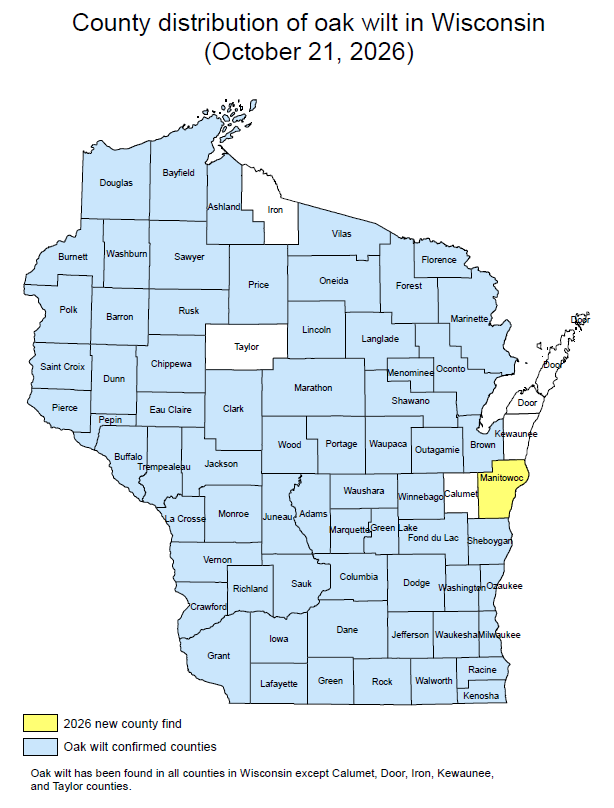
Oak wilt is already widespread across the southern two-thirds of Wisconsin and is increasingly being detected in northern parts of the state.
With the Manitowoc County discovery, the disease has now been confirmed in 67 of Wisconsin’s 72 counties.
Three nearby counties — Calumet, Door and Kewaunee — have never reported a confirmed detection.
Despite the discovery, the DNR expects the overall impact in Manitowoc County to be relatively limited. Oak trees account for less than 2% of the county’s forest trees and approximately 1% of its urban trees.
The disease does not affect other tree species.
How to Recognize Oak Wilt
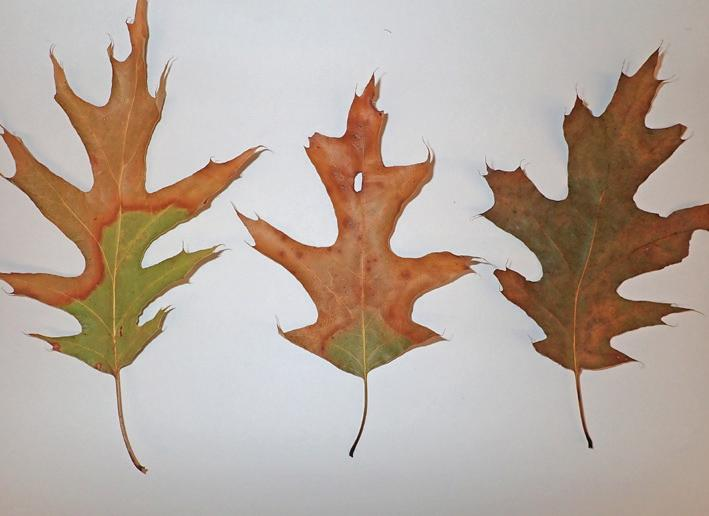
A leaf from the oak tree infected with oak wilt in Manitowoc County. Photo: Wisconsin DNR.
Oak wilt is caused by a fungus called Bretziella fagacearum, which disrupts a tree’s ability to transport water.
Symptoms are most noticeable during mid- to late summer, when infected trees may suddenly develop wilting leaves or begin dropping leaves well before autumn.
“These are not the brown, dry leaves you see in autumn,” McNee said. “These are often partially green and partially bronze.”
Homeowners should watch for:
- Leaves turning brown or bronze while portions remain green.
- Sudden wilting of leaves during the summer.
- Premature leaf drop, particularly in mid- to late summer.
- Branches showing signs of decline during the growing season.
These symptoms can resemble other tree problems, so laboratory testing may be needed to confirm an infection.
How Homeowners Can Help Prevent Oak Wilt
The fungus can spread through infected firewood and logs, as well as beetles attracted to fresh wounds on oak trees.
It can also move between neighboring oak trees through underground root connections.
The DNR recommends several precautions to reduce the risk of spreading the disease:
- Avoid pruning oak trees from April through July. This is the highest-risk period for transmission.
- Seal fresh wounds immediately. If an oak is damaged or must be cut during the high-risk period, apply water-based latex paint or pruning sealant to the exposed wood.
- Keep firewood local. Avoid transporting oak firewood or logs from areas where the disease is present.
- Allow cut oak wood to age. Leave oak firewood and uncut logs where they were cut for at least one year or until the bark naturally loosens.
Prevention Is the Best Defense
Once oak wilt becomes established, stopping its spread can be challenging and expensive.
Infected trees can transmit the fungus through connected root systems, while beetles can carry it longer distances to freshly wounded trees.
The DNR emphasizes that preventing the disease from entering new areas is significantly easier than attempting to contain an established infection.
Homeowners who suspect oak wilt are encouraged to seek guidance before removing or treating affected trees.
Additional information about identifying and preventing oak wilt is available on the Wisconsin DNR Oak Wilt webpage.
Source: Wisconsin Department of Natural Resources, Nov. 6, 2026.
