

MADISON, Wis. — Wisconsin deer hunters are being encouraged to test harvested deer for chronic wasting disease this fall as state wildlife officials continue monitoring both CWD and an outbreak of epizootic hemorrhagic disease in southeastern Wisconsin.
The Wisconsin Department of Natural Resources says hunter-submitted samples remain an important part of tracking the prevalence and spread of CWD across the state.
The agency is particularly interested in receiving additional samples from its 2026 Fall Priority Areas, which are located near recent CWD detections. More testing in those areas can help wildlife managers better determine disease levels and distribution.
How Hunters Can Test Deer For CWD
Any Wisconsin hunter can have a harvested deer tested for CWD.
The DNR offers several options:
- 24-hour self-service kiosks: Hunters can leave a deer head with at least 5 inches of neck attached. Supplies and instructions are provided at the kiosks.
- Cooperating businesses: Participating meat processors and other businesses can collect a deer head or remove lymph nodes for testing.
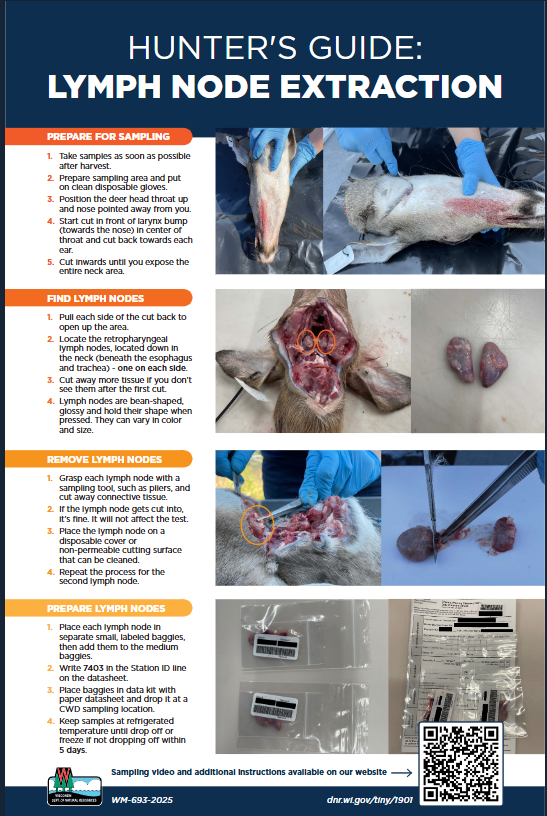
- At-home sampling: Hunters can pick up a kit, remove the retropharyngeal lymph nodes themselves and return the sample for testing.
- DNR appointments: Local wildlife management staff may be able to collect samples by appointment, although availability is limited.
Test results are typically available within two weeks, according to the DNR.
Hunters can use the DNR’s CWD Sample and Disposal Locations map to find nearby testing locations.
What Happens If A Deer Tests Positive?
Hunters whose deer test positive for CWD are eligible for a replacement harvest authorization.
According to the DNR, the authorization should appear in the hunter’s Go Wild account within two to four days after notification of the positive result.
A positive test from an antlered harvest authorization results in a replacement antlered authorization valid statewide. A positive result from an antlerless harvest registration results in an either-sex replacement authorization for the same deer management unit and land type.
The replacement authorizations are not weapon-specific and can be used for the remainder of the current hunting season as well as the following year’s hunting seasons beginning in September 2027.
Fewer Deer Carcass Dumpsters Available In 2026
The DNR is also reminding hunters that proper carcass disposal can help reduce the risk of introducing CWD into new areas.
However, hunters may notice fewer DNR-supported deer carcass waste dumpsters this season.
The department says rising operating costs and declining revenue have created a budget deficit that will limit some CWD-related efforts during the 2026 hunting season.
Dumpsters will still be available around Wisconsin, but at fewer locations than in previous years.
The DNR recommends hunters check its disposal location map throughout the season and consider other options when necessary, including:
- Municipal curbside waste collection where permitted
- Approved landfills or transfer stations
- Returning carcass waste to the location where the deer was harvested and burying it where feasible
Hunters should check with their municipality or waste provider before placing deer carcass waste in regular garbage.
Baiting And Feeding Restrictions
Hunters should also check whether deer baiting and feeding restrictions are in effect where they plan to hunt.
Current restrictions are available through the DNR’s Baiting and Feeding webpage.
Baiting and feeding rules can vary by county and can change following CWD detections, making it important for hunters to check current regulations before heading into the field.
Health Officials: Don’t Eat CWD-Positive Deer
The Wisconsin Department of Health Services, Centers for Disease Control and Prevention and World Health Organization recommend against eating meat from deer that test positive for CWD.
The DNR notes that infected deer can appear healthy for months after becoming infected. Health officials therefore encourage hunters to have deer tested, particularly when hunting in areas where CWD is prevalent.
There have been no reported cases of CWD infection in humans, according to the DNR release.
EHD Outbreak Continues In Southeastern Wisconsin
Meanwhile, the DNR continues to track an outbreak of epizootic hemorrhagic disease, or EHD, in southeastern Wisconsin.
The department is collecting reports of suspected EHD cases and has published preliminary county totals and a map of reported cases.
The DNR cautions that those numbers represent reports received by the agency. They are not an estimate of the total number of deer affected, and not every reported deer has been confirmed to have EHD.
Despite the outbreak, the DNR says the 2026 deer season will proceed under the current regulations with no reductions in harvest opportunities.
State wildlife officials say the history of deer harvest and current population levels indicate affected areas can still support an antlerless harvest this fall.
Some localized areas may experience significant deer mortality from EHD. However, unlike CWD, EHD outbreaks tend to have shorter-term effects, and the DNR says deer populations generally rebound relatively quickly.
Bottom Line
Wisconsin hunters heading into the 2026 season are being asked to help wildlife managers monitor the health of the state’s deer herd.
Testing harvested deer for CWD, properly disposing of carcasses and reporting suspected EHD cases all provide wildlife officials with information they can use to track the diseases. Check our Forecast Page for your hunting forecast.
