

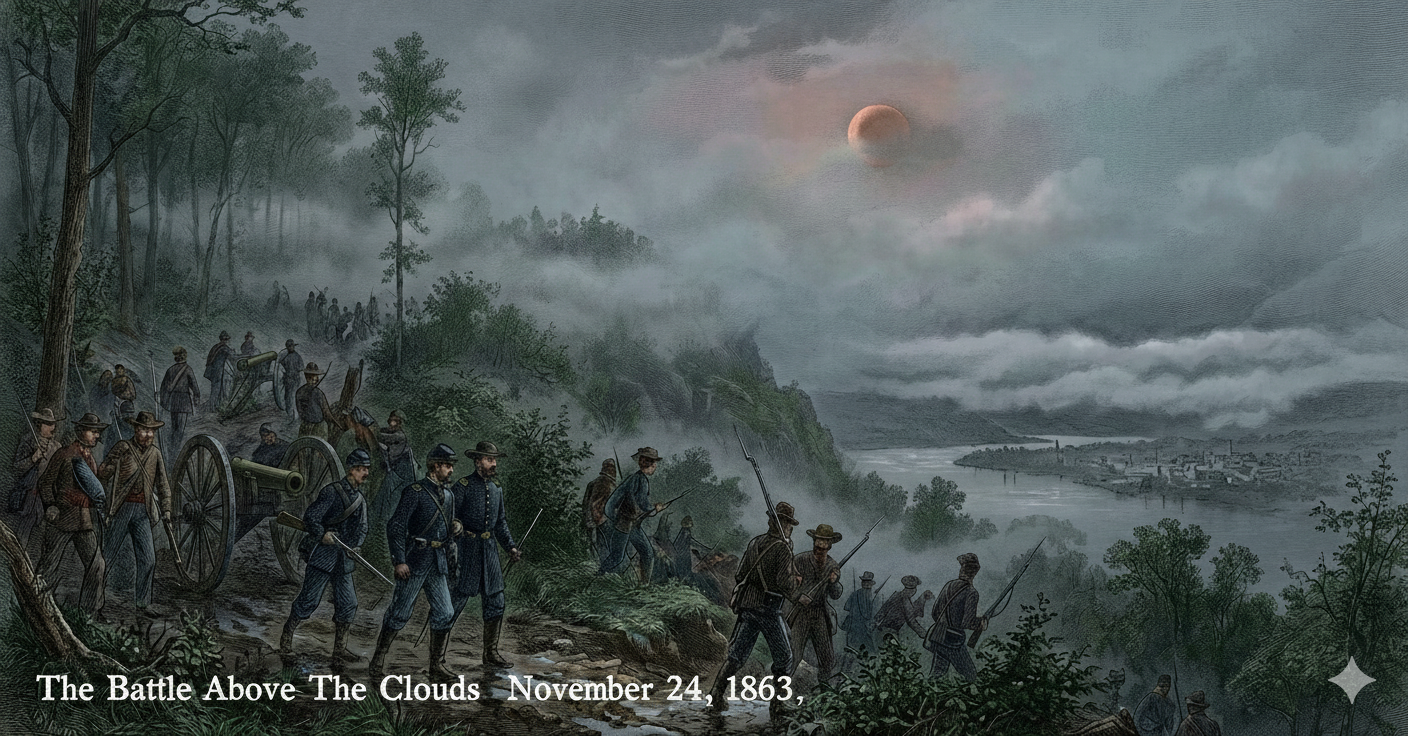
Discover how dense fog, low clouds, wet terrain, and even a lunar eclipse influenced the Battle of Lookout Mountain in 1863. A weather-driven look at the Civil War’s famous “Battle Above the Clouds” and its impact on the Chattanooga Campaign.
On Nov. 24, 1863, Union and Confederate forces clashed on the fog-shrouded slopes of Lookout Mountain during the Chattanooga Campaign. While the engagement is famous for its dramatic nickname — the Battle Above the Clouds — the title isn’t hyperbole. Weather played a pivotal role in shaping movements, visibility and ultimately the Union victory.
“The mountain’s strength was a myth.” — Historian Thomas L. Connelly
Confederate artillery atop the summit could not fire effectively through clouds or depress their guns enough to hit troops on the lower ledges.
A Battlefield Built by Weather
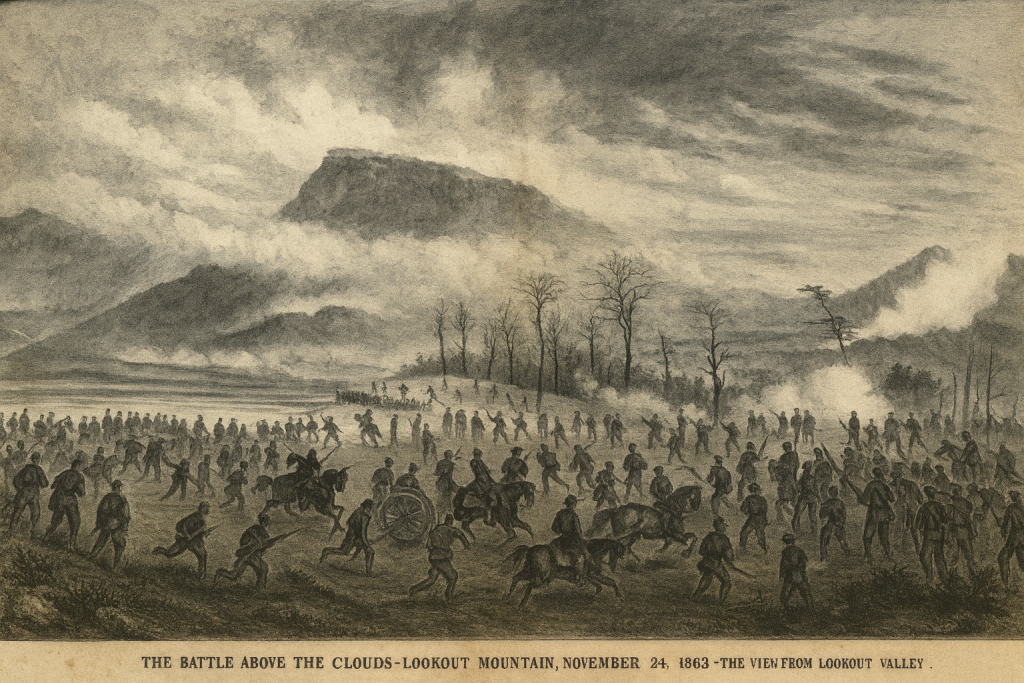
Lookout Mountain rises 1,800 feet above the Tennessee River, with sheer rock walls and a narrow “bench” partway up the slope. In late November, the Tennessee Valley frequently produces fog, low cloud decks and damp terrain, all of which set the stage for a unique kind of combat.
Union and Confederate veterans later described the mountain as slippery, wet and treacherous — ravines filled with moisture and rockfall made movement physically exhausting. The fog turned the natural fortress into a maze.
“Much of the ground over which we advanced was rough beyond conception.”
— Sergeant major, 96th Illinois, describing the wet, rocky ascent
Fog That Hid an Army
At dawn, low clouds blanketed the mountain. What should have been a visibility advantage for Confederate forces quickly became a liability. Hooker’s troops advanced across Lookout Creek and up the western slope with much of their movement concealed by fog.
Confederate artillery on the summit was effectively blind. Despite commanding views in clear weather, they could neither see their targets nor depress their guns enough to fire on the bench below.
This weather-induced blind spot allowed Union infantry to overwhelm picket positions and steadily push toward the Cravens house, a key midpoint on the mountain.
A Battle Inside the Clouds
By midday, the fight disappeared into the fog entirely. Observers from Chattanooga saw flashes and shadows, but the main action unfolded inside a cloud bank.
Quartermaster Gen. Montgomery Meigs was the first to call it “the Battle Above the Clouds.”
The cloud cover created confusion on both sides. Units became intermingled, officers struggled to locate their lines, and terrain amplified every misstep. But the Union advantage in numbers and momentum — aided by the concealment weather provided — eventually forced Confederate troops into retreat.
Moonlight, an Eclipse and the Retreat
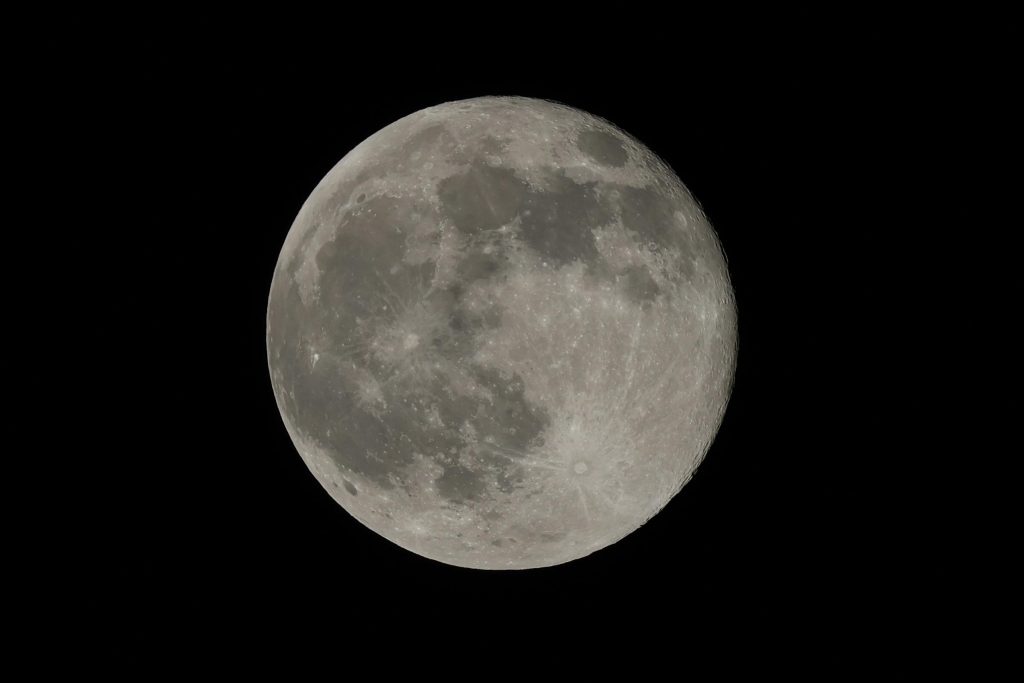
By midnight, firing had ceased. As Confederate forces withdrew from the mountain, soldiers witnessed a brilliant moon slip into a total lunar eclipse — an eerie atmospheric footnote to a day already defined by weather.
The withdrawal allowed Union troops to reposition and contribute to the decisive victory on Missionary Ridge the following day, lifting the siege of Chattanooga and opening the gateway to the Deep South.
Why Weather Mattered
Weather didn’t win the battle alone, but it reshaped everything about it:
- Fog concealed Union advances and neutralized summit artillery.
- Low visibility forced close-range combat on the bench and slopes.
- Wet, rugged terrain slowed movements, added fatigue and altered tactics.
Casualties were relatively light for a Civil War engagement — 671 Union, 1,251 Confederate — but the strategic impact was enormous.
Today, portions of the battlefield are preserved within the Chickamauga and Chattanooga National Military Park, where fog still clings to the slopes on cool-season mornings, giving visitors a glimpse of the same conditions that shaped the “battle above the clouds.”
References
- Connelly, Thomas L. Autumn of Glory: The Army of Tennessee 1862–1865. Louisiana State University Press, 1971. Quote referenced: “The mountain’s strength was a myth.”
- Cozzens, Peter. The Shipwreck of Their Hopes: The Battles for Chattanooga. University of Illinois Press, 1994. Source for multiple firsthand accounts, including the 96th Illinois sergeant major’s description of terrain conditions.
- Meigs, Montgomery C. Battlefield observations recorded in Union accounts; first to refer to the engagement as the “Battle Above the Clouds.” Summarized in Cozzens (1994) and Korn (1985).
- Korn, Jerry, and Editors of Time-Life Books. The Fight for Chattanooga: Chickamauga to Missionary Ridge. Time-Life Books, 1985. Contextual source for Meigs’ naming and weather conditions.
- National Park Service. Chickamauga & Chattanooga National Military Park documentation and historical summaries.
